
About the Course
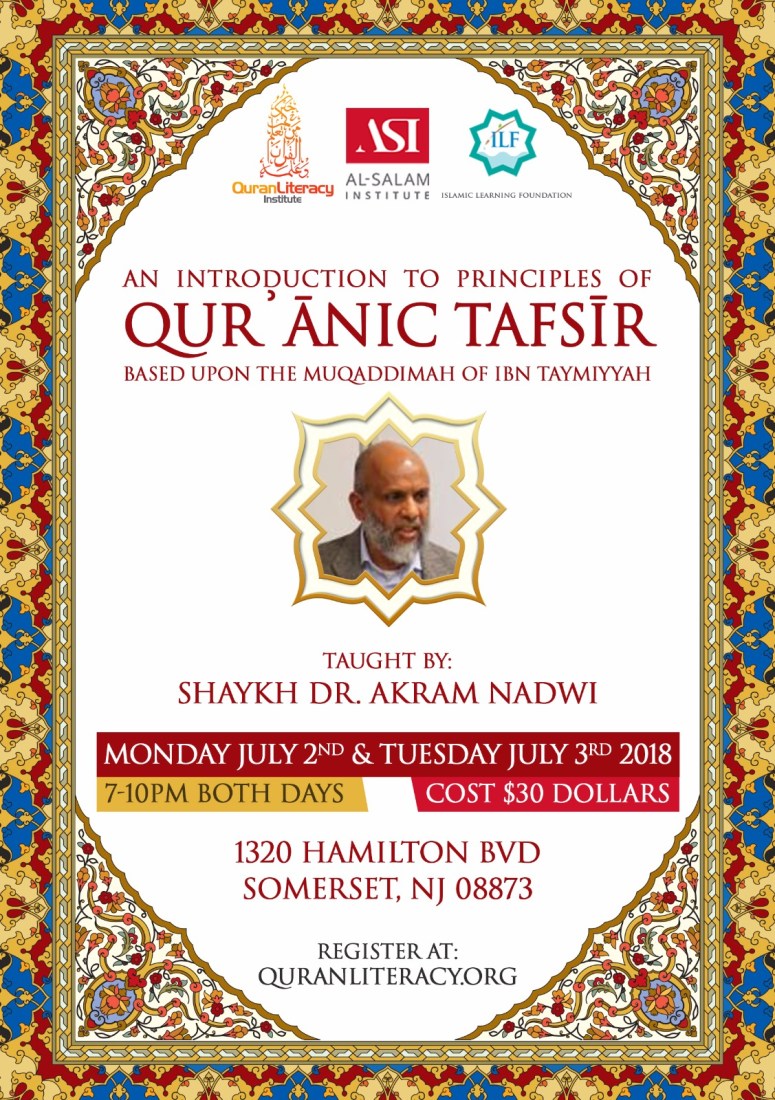
In this study of al-Muqaddimah fī Uṣūl al-Tafsīr, students will become acquainted with the essential principles in the interpretation of the Qur’an as authored by Shaykh al-Islam Ibn Taymiyyah.
This brief but comprehensive work on the principles of Tafsīr sets out the means by which a reader of the Qurʾān can determine what the Almighty is communicating to them through His Book; and what He expects them to do. Emphasis in this course is placed on understanding the thinking and reasoning of the author, and providing a detailed study of this work in comparison with other works of this genre.
Please note that due to limited seating, registration will be required for this seminar.
About the Text
Among the extant works of Ibn Taymiyyah is a small treatise entitled ‘Muqaddimah fī Uṣūl al-Tafsīr’ (An Introduction to the Principles of Qurʾān Interpretation’) that he dictated from memory whilst in prison in response to a question about proper Qurʾān interpretation (Tafsīr).
This work sets out the proper principles to be deployed in interpreting the Qurʾān and gives advice on the types of Tafsīr one should depend on from among the numerous works that are available. The text places emphasis on the fact that the reader of the Qurʾān should always keep in mind who the speaker is and who it is spoken to. It has proven to be a unique work in that, despite its conciseness, this small work of scholarship has been quoted by scholars from the earliest times like Ibn Kathīr and Suyūṭī unto the present day.
The Teacher: Dr Mohammad Akram Nadwi
Dr Mohammad Akram Nadwi is a world-renowned scholar of Indian origin, who has now resided in England for many years. He is recipient of the Allama Iqbal prize for contribution to Islamic thought and is the Principal and co-founder of Al-Salam Institute.
After receiving advanced in-depth training in the traditional Islamic disciplines at Nadwat al-ʿUlamāʾ (Lucknow, India) and receiving a PhD in Arabic literature from Lucknow University, he became a Research Fellow at the Oxford Centre for Islamic Studies where he conducted research for a number of years (including on the topics of ḥadīth and Sufi orders in India). He has published widely in Urdu, Persian, Arabic and English. This includes translations (such as his work on Shāh Walīullah), editions of Arabic texts (such as a renowned critical edition of Uṣūl al-Shāshī in Ḥanafī jurisprudence), and original monographs (on Islamic law, hadith sciences and figures such as Abū Ḥanīfah and Sayyid Abul Ḥasan ʿAlī Nadwī). As co-founder of Al-Salam Institute, he continues to teach short courses and Advanced Level modules on the Islamic Scholarship Programme.
He is also author of Al-Muhaddithat: The Women Scholars in Islam, a monumental 53-volume biographical dictionary which charts some of the significant contributions made by female ḥadīth scholars over the centuries.

 Quran Literacy Institute